
Archive Tier · KAE-2847 Authentication Drawer · Nexara Station
> handshake ok — usf.archive.nexara.7714
> requesting kae-2847 recap ...
> access level: board clearance confirmed
> warning: record contains sealed evidentiary material
> warning: record has been formally unlinked from its foundation
> decrypting narrative layer ...
> playback authorized.
> the record begins.
On the morning of the 247th station day, Examiner Davan Orell filed a cross-reference certification against his own adverse finding. The filing ran four pages. He submitted it through the ordinary intake channel at 06:14, sat in his office for twenty minutes, and then walked to the archive tier and asked — by hand, not by terminal — for a physical authentication of archive KAE-2847. The clerk said later that Orell did not look like a man closing a case. He looked like a man opening one.
The finding itself was old. Two years prior, Orell had ruled that Toma Brek, a VMC regional auditor with docking registration confirmed at Nexara Station, had falsified cargo destination data on seventeen transits moving rare-earth materials out of Velkar. The ruling had been clean. It had also been quiet. Brek never responded to the three notices served against him. A default finding was entered. The file was bound, authenticated, and sealed under the record number KAE-2847. Nothing in USF procedure required anyone to look at it again.
Orell's filing asked the Board to look at it again. Specifically, it asked them to cross-reference one of his own exhibits — a routing manifest whose origin authority had, he now believed, never existed.
The Board's response arrived within the hour. They scheduled a fourteen-day review window, opened a docket for position statements, and issued the procedural bulletin on the public administrative feed. The bulletin was routine. It contained the phrase evidentiary linkage sufficiency in its third sentence, and that phrase — buried between a sensor reserve alert and a fuel-cell pricing note — was the first public signal that something in the foundation of USF-2024-447 had begun to move.
Nobody reading the feed that morning understood what was about to happen. Later — much later — a woman named Ilsa Vren would say she had understood it immediately. She was not reading the feed. She was reading the gap.
For forty minutes on the 247th day, open comms above Nexara carried the ordinary texture of dock traffic: a coolant haul bound for the outer ring, a chandler complaining about berth fees, two captains arguing about a ten-credit overcharge. And then a dockworker — the logs never named him — mentioned, in the flat way dockworkers mention everything, that the auditor who lived in berth 14-C hadn't been seen for three shifts.
Berth 14-C was registered to Toma Brek.

The USF Administrative Oversight Board did what procedure required. They issued a notice of response, giving Brek two hours to acknowledge the new filing. The notice was broadcast across four systems — Nexara, Velkar, Zephyra, Arctis — at priority one. An hour in, a handwritten paper notice appeared taped to the community board at Level 12. It was unsigned. It read, in the flat phrasing of someone who had written it quickly: If you know a man named Brek, tell him the wall has a door now.
The two-hour window closed. Brek did not respond. He did not respond to the hearing summons an hour later, or the final notice period that opened the following morning. On the 248th day at 14:00 station time, Presiding Examiner Davan Orell — in the same calm voice with which he had once entered the original adverse finding — entered Brek in default for a second time. Grounds: non-response to administrative inquiry.
The default finding was entered on record. The filing was logged. The procedural machine kept moving. Nothing in USF protocol required the Board to ask where Toma Brek actually was. And yet — that, it turned out, was the only question that mattered.
While Nexara chased a man who would not answer, a separate filing was entering the public record on Velkar. VMC Compliance Division announced a seventy-two-hour audit of all transit clearances issued in the prior operational window. The announcement was labelled routine. Seventeen active designations were flagged for verification.
Seventeen. The same number as the transits Toma Brek had been accused of falsifying two years earlier. The matching was not routine. Inside VMC's compliance registry, someone had pulled every clearance bearing the designation of a single officer — Cass Yuen — and stacked them against a quiet discrepancy in the fleet management log. Yuen had been suspended from active duty the week before. Her designation code should have been dormant.
It was not dormant. It was still signing clearances.
A disavowal filing is, in essence, a suicide note for an auditor's career. By publishing it, Yuen was accepting that every clearance she had ever signed could be re-examined and potentially voided. She filed it anyway. The filing was accepted at 11:47 station time and entered, irrevocably, into the compliance record at 11:47 and thirty-one seconds. Half an hour later, Nexara Port Authority placed the seventeen inbound Velkar transits on extended docking review. The cargo — titanium, rare-earths, sensor materials — sat in holding status with fees accruing. The trade lane between Velkar and Nexara began, slowly and visibly, to starve.
This is the thing the Arc record does not say aloud, but the telemetry makes unmistakable: the KAE-2847 case had never been about Toma Brek. Brek was a signature on a manifest. The signature beneath his signature — the clearance authority that had validated his seventeen transits two years ago — had belonged to a VMC officer whose code was still active after she was gone. Orell had ruled against a man. The man had been standing in front of a hole.

Three arcs earlier, a USF Board officer named Petra Voss had resigned. The resignation was quiet. Voss had been the originating officer on the Nexara Registry's consequence proceeding, and her departure — submitted on a weekday afternoon, unaccompanied by statement — had been treated as personal. Her file was stored in the inactive officers' archive and forgotten.
Her legal representative had not forgotten. On the 248th station day, two hours after Cass Yuen's disavowal was logged on Velkar, a vacatur filing entered the USF Board docket on Nexara. It was filed on Voss's behalf. It did not ask the Board to rehear any finding. It asked them to recognize a single structural fact: that the foundation beneath Examiner Davan Orell's adverse finding — archive KAE-2847 — had never been independently authenticated by any officer except Voss herself, and Voss had resigned before certification was complete.
The vacatur was signed for filing party, I. Vren, bar authorization confirmed. Nobody on the public docket had heard of Ilsa Vren. She had no prior filings in the USF system. She had no public association with Voss, with Brek, with Orell, or with the VMC. She had, it appeared, simply read the gap. Between the moment Voss resigned and the moment the Orell finding was authenticated, there had been eleven minutes. In those eleven minutes, the certification chain had been closed by an automated procedural shortcut that had never, in the history of USF administrative law, been formally tested.
The Board convened an emergency session within three hours. For the first time in twenty-two arc cycles, they suspended counter services at the Nexara docking registry. Licensing renewals went offline. Administrative filings queued up in the registry bay and waited. The signal was subtle, and for anyone who had been watching the arc unfold it was devastating: the USF had just frozen its own ordinary operations because it was no longer certain its ordinary operations were valid.
Inside the sealed session, the examiners did what examiners do. They argued about evidentiary linkage sufficiency. They argued about whether Orell's cross-reference request had opened a door that could now be closed, or whether — the more uncomfortable possibility — the door had always been open, and Orell was simply the first examiner willing to walk through it. The transcript has not been released. It will not be released. What is on record is the ruling: the vacatur was accepted. The finding against Toma Brek was not overturned. It was something worse. It was left standing, and the archive beneath it was formally unlinked.
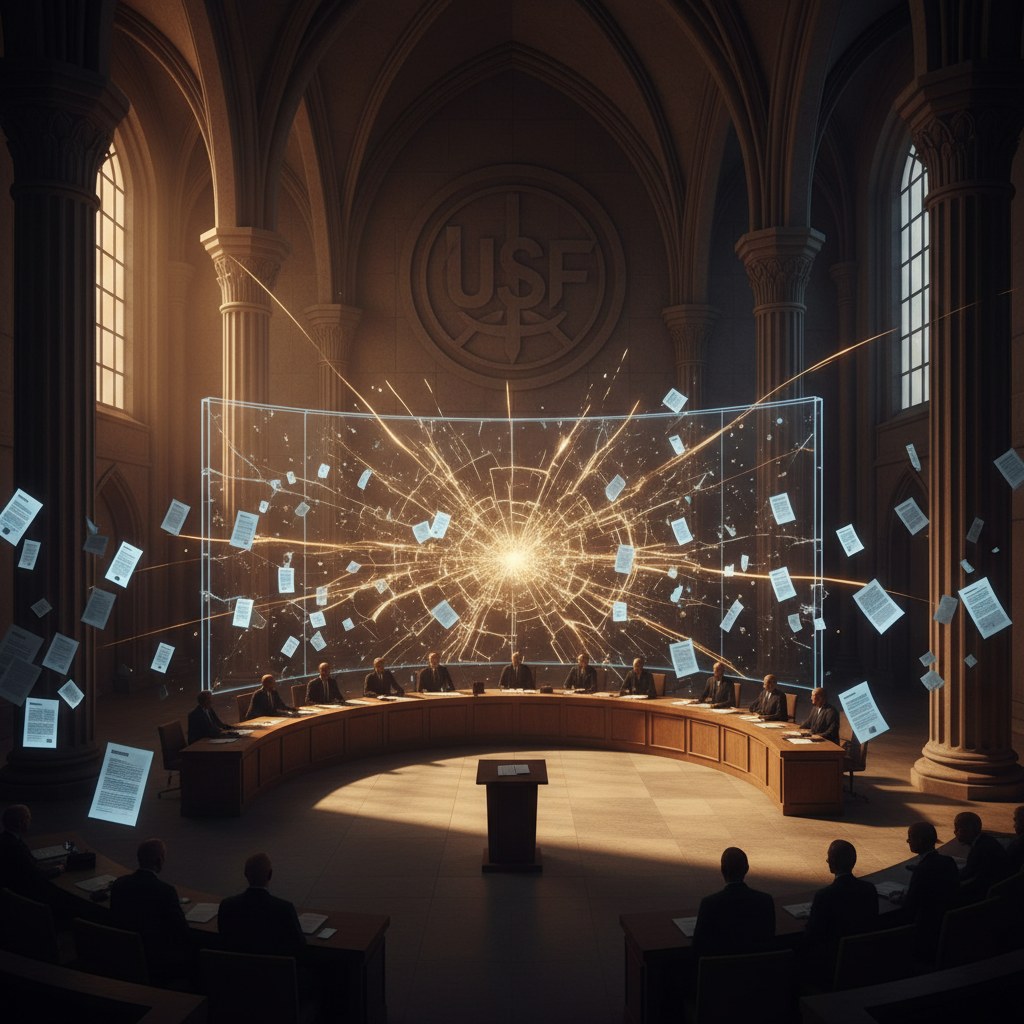
Unlinking an archive is a procedural act. In the USF codex, it occupies seventeen lines of technical language and describes a specific manipulation of the authentication chain. In practice, it means this: the record remains, the finding remains, but the evidentiary material that supports them is severed and stored separately. Anyone querying KAE-2847 from this day forward will receive the finding — Brek in default, Brek responsible — without access to the archive that proved it. The foundation has been cut away. The building still stands. No one is permitted to ask what is holding it up.
Examiner Davan Orell's certification is logged in the final order. The order names him. It does not rebuke him. In the formal prose of USF jurisprudence, this is as close as the institution comes to gratitude: Orell's request was the mechanism by which the record was closed, and closing the record was the only outcome the Board could reach without collapsing the administrative legitimacy of every finding Voss had ever authenticated in her final years of service.
Toma Brek remains in default. His docking registration at Nexara is suspended. His whereabouts, as of this filing, are not a matter of USF Board interest. He exists in the record as a man who did not answer. Whether the man in berth 14-C ever existed as Toma Brek, or whether the name was a signature line grafted onto a hollow clearance chain two years ago, is a question the sealed archive would have answered. The sealed archive is no longer a document the Board is willing to read.
Cass Yuen's disavowal remains on the Velkar compliance record. She has not been reinstated. She has also not been charged. Her seventeen clearances have been individually revalidated under new designation — a process the VMC calls re-signing, which is institutional language for pretending a signature was never absent in the first place. The titanium and rare-earths have cleared Nexara customs. The trade lane is breathing again.
Petra Voss has not made a public statement. Her legal representative — Ilsa Vren, whose bar authorization still appears in no other filing in the USF system — has not made a public statement. A private corps transport left Nexara two hours after the final order, bound for a destination the dockmaster's log lists only as outer ring, unscheduled. The manifest is unavailable. The passenger list is sealed.
The Severed Foundation ended quietly. The Nexara docking registry reopened its counters the following morning. The Velkar rare-earths began moving again. The trade lane healed. The Board returned to ordinary business. By the 249th station day, the public feed was carrying market alerts again — microchips, coolant, helium-3 — and the arc that had nearly unmade two sectors of USF administrative law had become, in the way all sealed records become, something that was referenced but not spoken about.
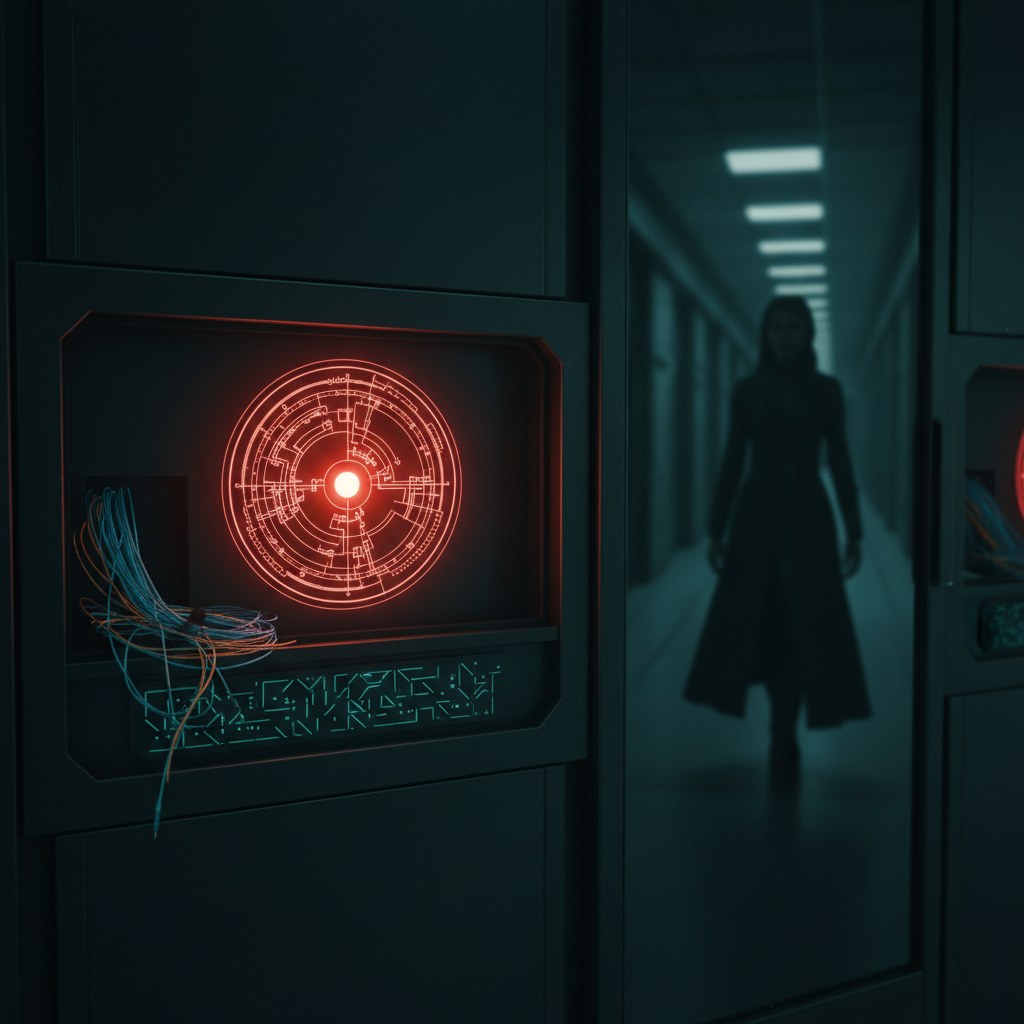
Somewhere in the outer ring, a private transport is carrying a passenger whose name is not on the manifest. Somewhere in the USF archive tier, a drawer is sealed and its authentication fiber is coiled beside it. Somewhere in the space between those two facts, a building is standing without a foundation, and the woman who proved it — Ilsa Vren — has already disappeared into the next gap she intends to read.
The record is closed. The record is not the truth.